
Life is a lot like watching a massive Siberian crane prepare for its migration. There is this hesitation, this moment where the great creature must trust an invisible current—the wind—to carry its heavy existence thousands of miles. That precise moment of letting go is exactly where Isuzu Motors finds itself now, not with feathers and altitude, but with steel, sensors, and the vast, demanding ribbon of the Japanese expressway.
They are preparing a self-driving heavy-duty truck for trial runs, a significant logistical journey linking Tochigi Prefecture and Aichi Prefecture, specifically along a critical expressway section. This effort is not merely about moving spare parts; it's about gracefully navigating a profound societal change, gently nudging the future of logistics toward the inevitable ease that automation promises amid serious driver shortages.
The truck itself is a beautiful, complicated piece of mechanical hope, born from a deep collaboration between Isuzu and the brilliant engineers at Applied Intuition Inc., a U.S. startup specializing in autonomous vehicle development.
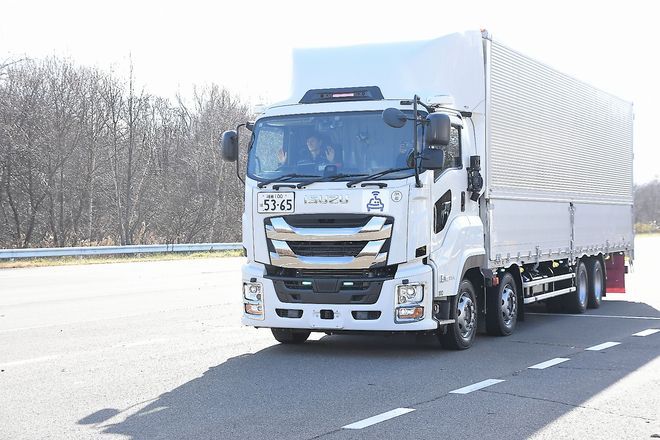
We saw a glimpse of this intelligence in Mukawa, Hokkaido, where the truck utilized LiDAR, that sophisticated laser light technology, to truly *see* the world—registering every approaching vehicle and sensing the environment with a measured precision our own tired eyes rarely achieve. It executed a pass and changed lanes smoothly.
But here is the tender part, the moment of necessary human grace: A human driver remains inside. They serve as the constant sentinel, keeping watch over the operating conditions, ready to take the wheel in an instant if an anomaly should arise. As Isuzu senior executive officer Hiroshi Sato observed, their technology already copes fully with typical traffic scenarios; the continued development is aimed at handling those cases that may arise on rarer occasions.
Why this elaborate technological ballet?
Because the reality is heavy: Japan faces a serious, accelerating shortage of commercial drivers. Automation, in this context, is not a distant science fiction luxury; it is an immediate economic necessity, a practical solution to a physically strenuous problem. This rigorous test operation will stretch from January through the spring next year, meticulously documenting every kilometer the vehicle drives itself.
It is a methodical, essential march toward greater capacity and, ultimately, a lighter burden on the dedicated individuals who keep our world moving. We are simply trying to help the road carry its weight.
The allure of a world where roads are traversed by vehicles unencumbered by human hands has long fascinated me. As I ponder the implications of this technology, I am reminded of a recent report by The Asahi Shimbun, which highlighted the strides being made in self-driving truck technology testing. In the United States, companies like TuSimple and Aurora are leading the charge, collaborating with major trucking firms to put their autonomous vehicles through rigorous testing on public roads.
One of the most significant advantages of self-driving trucks is their potential to revolutionize the logistics industry.
With the ability to operate around the clock without the need for rest breaks, these vehicles could dramatically increase efficiency and reduce costs. By minimizing the risk of human error, they could also make roads safer for everyone.
According to The Asahi Shimbun, several Japanese companies, including Honda and Nissan, are also investing heavily in the development of self-driving truck technology, with the goal of deploying fleets on highways in the near future.
As I consider the possibilities presented by this technology, I am struck by the notion that the boundaries between human and machine are becoming increasingly blurred.
While some may view this as a threat, I see it as an opportunity for growth and innovation.
Alternative viewpoints and findings: See hereA self-driving truck, rolled out by Isuzu Motors Ltd. to media representatives, steers itself autonomously in Mukawa, Hokkaido, on Nov.○○○ ○ ○○○


No comments:
Post a Comment