
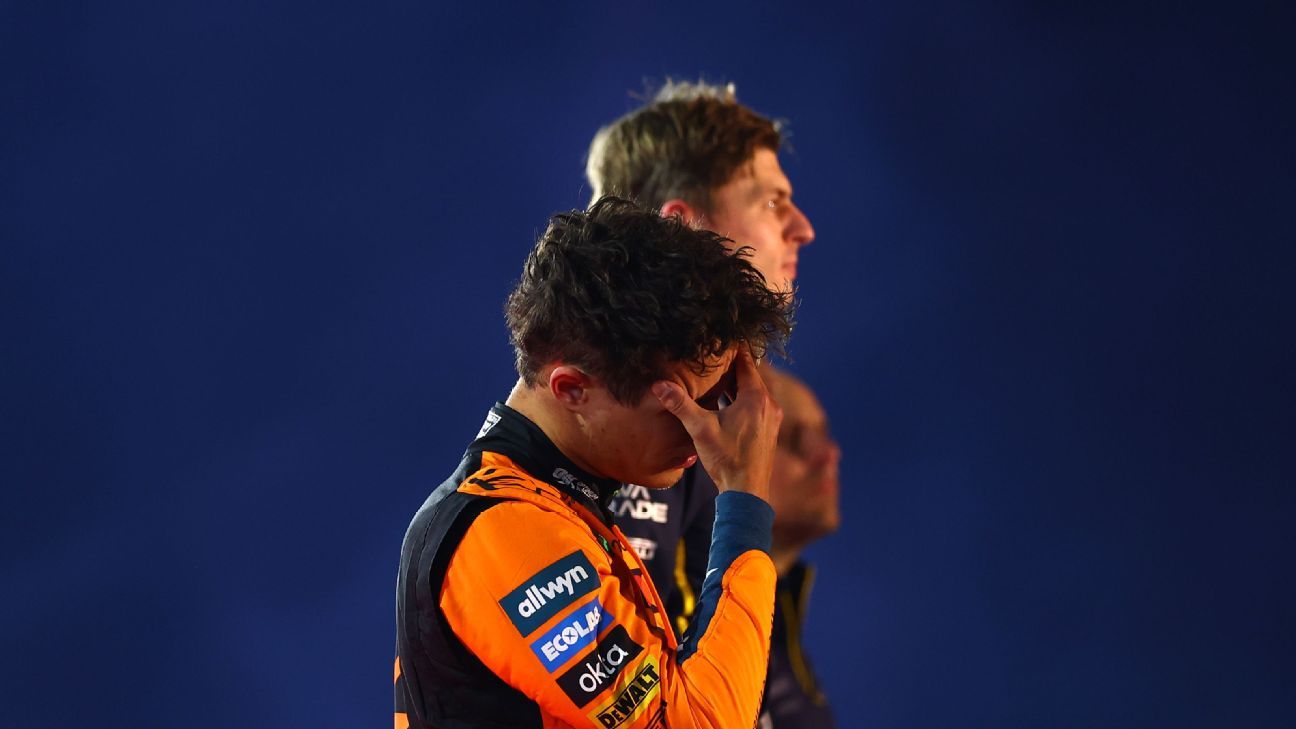
McLaren Team Principal Andrea Stella has come out in defense of his team's car setup at the Las Vegas Grand Prix, despite Lando Norris and Oscar Piastri being disqualified due to excessive plank wear. The disqualifications, which stripped Norris of his second-place finish and Piastri of his fourth-place finish, have reignited the Formula 1 title battle with Max Verstappen and two rounds remaining.
According to Stella, McLaren did not take excessive risks with its car setup, but rather made a genuine error due to the lack of dry-weather practice. "Based on the data we had acquired in practice, we do not believe we took excessive risks in terms of ride height," Stella said. "We also added a safety margin for qualifying and the race, compared to practice, in terms of clearance to the ground." However, Stella explained that the team's safety margin was negated by the unexpected onset of large vertical oscillations, which caused the car to touch the ground.
The team's car developed a porpoising condition during the race, which was difficult to mitigate. "Even a reduction in speed -- an action that, in theory, should increase clearance to the ground -- was only effective in some parts of the track but in others was actually counterproductive," Stella said.
The art of fine-tuning a Formula 1 car's aerodynamics is a delicate balancing act. Teams must navigate the intricate dance between downforce and drag, as the slightest miscalculation can have a profound impact on a car's overall performance. The rear wing, in particular, plays a crucial role in this equation, as it generates a significant portion of the car's downforce. However, as teams push the boundaries of aerodynamic innovation, they must also contend with the ever-present threat of porpoising - a phenomenon in which the car's oscillations cause it to bounce up and down, sapping precious speed and stability.
At the heart of this challenge lies the complex interplay between the car's aerodynamic devices and its suspension system.
As teams strive to optimize their car's aerodynamic performance, they must also ensure that the suspension is capable of coping with the stresses and strains imposed by the car's aerodynamic demands.
This requires a deep understanding of the intricate relationships between the car's various components, as well as a keen sense of intuition and instinct.
The best teams in Formula 1 are those that can marry cutting-edge technology with old-fashioned ingenuity, yielding a car that is both quick and reliable. Despite the many advances that have been made in Formula 1 aerodynamics, the sport ___ as much an art as it is ← →
Other references and insights: See hereMcLaren team principal Andrea Stella has insisted that his team did not take excessive risks with its car setup at the Las Vegas Grand Prix despite ...●●● ●●●


No comments:
Post a Comment