
The purple patch persists. A steady light cast over high-end electric motorsport, one defined by the imminent Gen4 era of Formula E—cars promised real downforce, almost doubled power—and the intricate physics of F1's renewed electrical push, coupled with active aerodynamics. Out in the regulated sun of the Middle East, the A2RL crews orchestrated another impressive sequence at Yas Marina, autonomous single-seaters executing a pattern of competition significantly more compelling than previous attempts.
These are the parameters of the present, the official specifications.
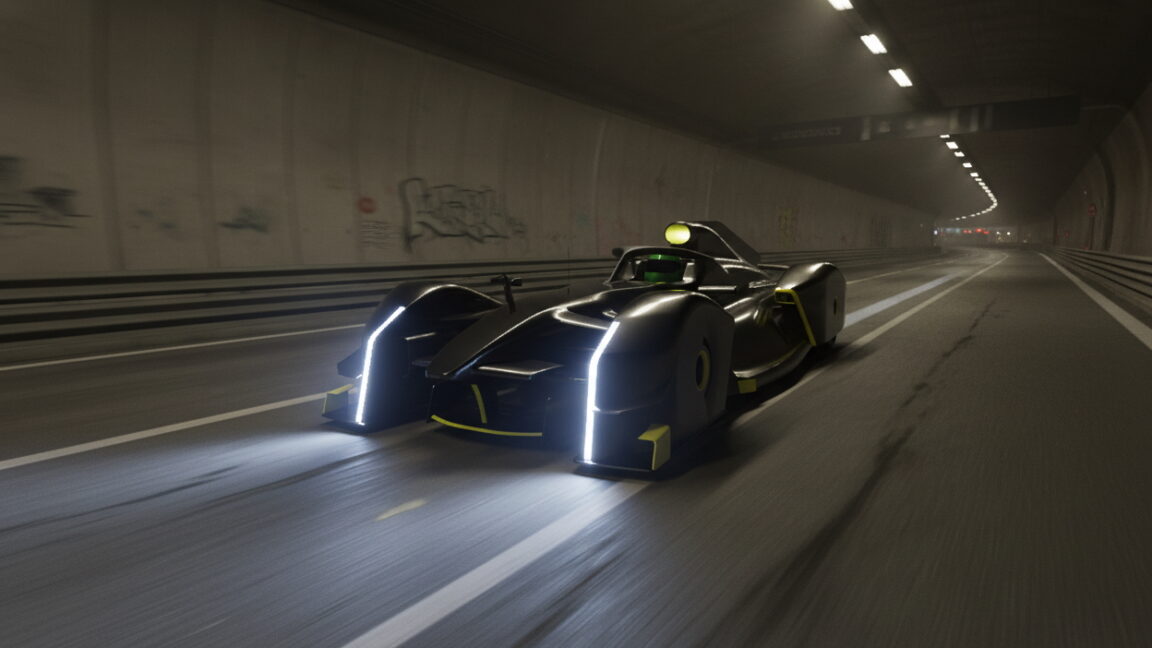
But there is a calculation running outside the official series. What if the constraint wasn't the mandate? The question asked by Lucas di Grassi—champion driver, philosophical advocate for clean technologies—and the re-emergent British legacy, Lola Cars. The result: the DRG-Lola, a single-seater concept engineered for pure velocity, designed to exploit technologies the rules currently prohibit.
A ghost car faster around a course like Monaco than any of its established competitors.
The engineering relies not on vaporware but on existing, validated components. The required energy is sourced from a 60 kWh battery pack, modules arranged tightly on either side of the cockpit, feeding twin electric motors.
804 horsepower—600 kW—distributed precisely across both the front and rear axles. Unlike the open-wheel spectacle of F1, the DRG-Lola features covered wheels. A practical heresy. The concept, which significantly reduces the car's drag coefficient, immediately evokes the Adrian Newey designs—the X2010, the X2019—concepts previously confined to the pristine circuits of the Gran Turismo simulation.
Lower drag equals less energy expended pushing air, resulting in significantly extended race distances. A matter of endurance through efficiency.
Downforce is the true differentiator. While the car generates substantial high-speed grip via its underbody and diffuser—simulations by Lola indicate 530 kg of downforce already achieved at 180 km/h—di Grassi has pushed the boundaries of low-speed adherence. A methodical approach.
It is an exploration of physics divorced from the limiting regulations, a pursuit of grip that promises performance metrics outside the usual band of high-speed racing. A concept built on necessity, demonstrating that the future of speed is less about burning fuel and more about the rigorous, specific deployment of watts and refined aerodynamics.
We're in something of a purple patch if you're a fan of clever new technology in single-seat race cars.Find other details related to this topic: Check here



No comments:
Post a Comment