
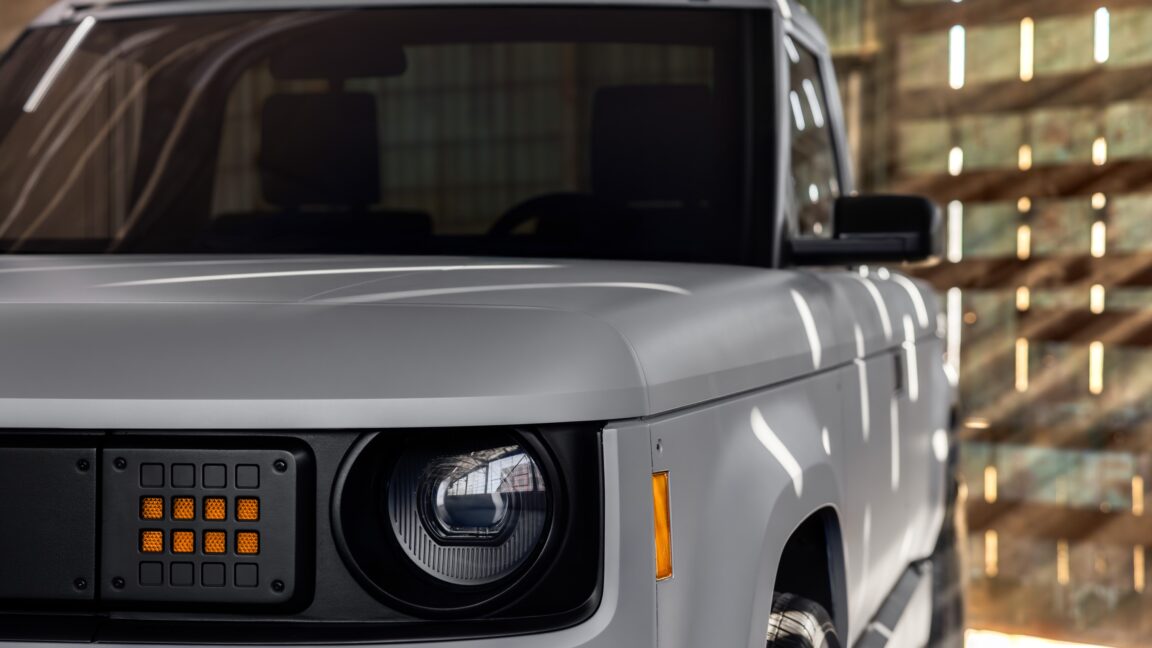
In a move that's left some in the industry scratching their heads, Slate Auto, the startup backed by the billionaire behind Amazon, has unveiled its first foray into the electric vehicle market with the Blank Slate truck. This unusual vehicle promises to deliver a claimed 150 miles of range on a single charge, all for under $20,000 - a price point that's tantalizingly close to the oft-cited magic number of $25,000. But, as with all things that sound too good to be true, there are some concerns that need to be addressed before this truck hits the road.
The Blank Slate is all about giving buyers the freedom to customize their vehicle to suit their needs, with a flat-pack accessory SUV Kit that turns the truck into a five-seat SUV or an open-air rig. And with a choice of two battery packs, "buyers can choose between a 57."2 kWh unit that'll get them 150 miles on a charge... or an 84. 3 kWh unit that'll give them a whopping 240 miles.
The truck's acceleration is similarly unassuming... with a 0-60 mph time of 8 seconds and a top speed of 90 mph.
The Slate Truck is an electric vehicle (EV) developed by Slate Auto, a startup backed by Jeff Bezos. The vehicle boasts a claimed 150 miles of range at a starting price of less than $20,000, assuming federal clean vehicle tax credits continue to exist. The truck features a modular design, with a "flat-pack accessory SUV Kit" that allows users to convert the vehicle into a five-seat SUV or an "open air" truck.
The truck is equipped with a NACS charging port and can charge to 80% in under 30 minutes. The Slate Truck's specifications are impressive, with a 201 hp (150 kW) motor, 195 lb-ft (264 Nm) of torque, and a top speed of 90 mph (145 km → h). However, "the spec sheet raises concerns about production and safety." The truck's price, particularly the sub-$25,000 target... is a significant hurdle for the startup.
The myth of affordable EVs has been perpetuated by Tesla's perpetual promise of an affordable option... but the challenge of delivering on that promise --- a significant obstacle for Slate Auto and other EV startups.
●●● ●●●
The Electric Vehicle Revolution Affordability vs. Reality
The electric vehicle (EV) market is in a constant state of evolution, with new models and technologies emerging at a rapid pace. While advancements in range, charging speed, and performance dominate headlines, a crucial aspect often takes a backseat: affordability. The single most important factor for widespread EV adoption is making them accessible to a broader range of consumers, and that means driving down the initial purchase price. This article will explore the challenges and potential breakthroughs in the quest for affordable EVs, particularly in light of recent developments.
The $25,000 Barrier: A Psychological Threshold
The $25,000 price point has become something of a holy grail in the EV industry. It represents a price where EVs begin to compete directly with traditional gasoline-powered vehicles, especially when factoring in potential savings on fuel and maintenance. Crossing this threshold has the potential to unlock mass-market adoption, drawing in budget-conscious buyers who have previously been priced out of the EV market.
Range vs. Cost: A Delicate Balancing Act
One of the biggest challenges in creating affordable EVs is the battery. Batteries are currently the single most expensive component in an electric car, directly impacting both the vehicle's range and its price. Manufacturers face a difficult trade-off: provide a shorter range at a lower price or offer a longer range at a higher cost. This creates a need for innovative battery technologies, more efficient vehicle designs, and creative business models to help consumers bridge the cost gap.
Beyond the Sticker Price: Considering Total Cost of Ownership
While the initial purchase price of an EV is important, it's crucial to consider the total cost of ownership. EVs typically have lower running costs due to cheaper electricity compared to gasoline, reduced maintenance requirements, and potential government incentives. These long-term savings can offset the higher initial price, making EVs a more economically viable option for some consumers. However, accurately calculating and communicating these savings is key to convincing potential buyers.
The Rise of Simplified EVs and Innovative Business Models
As the industry matures, some manufacturers are exploring innovative approaches to bring down the cost of EVs. This includes simplifying vehicle designs, focusing on essential features, and using alternative battery chemistries. We're also seeing the emergence of new business models, such as battery leasing programs, that can significantly reduce the initial purchase price of an EV.
Challenges and Opportunities
The quest for affordable EVs is fraught with challenges, including fluctuating battery raw material prices, the need for robust charging infrastructure, and consumer perceptions about range anxiety. However, the potential rewards are enormous. By making EVs more accessible, we can accelerate the transition to a cleaner, more sustainable transportation system. The key lies in continued innovation, strategic partnerships, and a relentless focus on driving down costs without compromising quality or safety.
Electric trucks.
The electric truck market has been gaining traction in recent years, with several manufacturers vying for a share of the pie. The latest entrant in this space is the Blank Slate truck, unveiled by Slate Auto, a startup backed by a prominent billionaire. This truck boasts an impressive claim of 150 miles of range on a single charge, all for under $20,000. The price point is tantalizingly close to the oft-cited magic number of $25,000, sparking excitement among potential buyers.
The Blank Slate's design is notable for its simplicity, with a flat-pack accessory SUV Kit that allows buyers to customize the truck to suit their needs. The kit transforms the truck into a five-seat SUV or an open-air rig, "giving users the freedom to choose how they want to use their vehicle." The truck's acceleration is similarly unassuming... with a 0-60 mph time of 8 seconds and a top speed of 90 mph. Despite these impressive specs... the real question is whether the Blank Slate can hold its own in a crowded market dominated by established players.
This article was obtained from Ars Technica.
In one of the strangest launches we've seen in a while, Slate Auto, the reportedly Jeff Bezos-backed electric vehicle startup, unveiled its first EV, the Slate Truck. Notably, the vehicle is capable of a claimed 150 miles (241 km) of range at a starting price of less than $20,000, assuming federal clean vehicle tax credits continue to exist.●●● ●●●
Slate caused a lot of social media froth when it parked a pair of styling concepts (not functional vehicles) in Venice, California, advertising bizarre fake businesses. Today, the company unveiled the vehicle to the press at an event near the Long Beach Airport.


No comments:
Post a Comment