Wednesday, December 3, 2025

# The Invisible Current: Batteries and Range Anxiety

We often wait for a sudden, total revolution, forgetting that true liberation arrives quietly, one small assisted movement at a time. The push is already within you; sometimes, it merely needs a precise, calibrated electrical current to be revealed.

The electric bicycle is not simply a traditional frame fitted awkwardly with a battery and motor, but a profound re-engineering of kinetic effort. It stands at the intersection where analog mechanics meet precise, digitally managed electrical energy, redefining the psychological limits of distance and ascent. Understanding the e-bike necessitates focusing not only on its physical structure but on the invisible, potent dialogue occurring continuously between the rider, the sensor, and the power unit. It is a machine designed to amplify, never to replace, the fundamental human necessity of motion, resulting in an object whose operation is simultaneously familiar and uniquely perplexing.

The majority of modern e-bikes depend on lithium-ion chemistry, predominantly utilizing cells in formats such as the ubiquitous 18650 or the denser 21700. These cells are silent, standardized reservoirs of potential, their high energy density being the single most defining factor allowing for practical, lightweight integration into the chassis. This powerful storage, however, carries a confusing vulnerability: temperature. A cold morning, for instance, significantly reduces the chemical reaction efficiency, instantaneously curtailing a stated fifty-mile range to thirty-five. The actual capacity of the battery pack (measured in Watt-hours, Wh) is mediated by the sophisticated and entirely necessary Battery Management System (BMS). The BMS oversees cell balancing, controls charging rates, and prevents the cascading internal failure known as thermal runaway—a silent terror for the conscientious owner. The energy itself is a delicate balance.

Kinetic Dialogue: Motor Placement and Power Delivery

The location of the motor defines the very character of the assisted ride, generating two distinct types of electrical experience. A hub motor, integrated directly into the rear or front wheel axle, is perhaps the most straightforward mechanism, providing immediate, unmodulated thrust. It is a predictable friend, often using a simple cadence sensor to initiate assistance when the pedals move. The mid-drive system, situated near the crank and bottom bracket, is intensely clever and often far more confusing for the casual observer. It leverages the bicycle's existing drivetrain; the motor output is filtered through the selected gear ratio, meaning a small shift in the chainring creates a magnified surge of torque. This complexity relies on advanced torque sensors that measure the precise force applied by the rider's foot, ensuring the assistance feels organic and proportional. A sudden, unintended downshift on a steep incline can momentarily confuse the torque sensor's interpretation of rider input, leading to a brief, jarring over-delivery of power—a disconcerting incident many riders experience early in their tenure. This integration is intensely complex.

The Intricate Wiring of Regulation

The regulatory landscape layered onto these devices introduces bureaucratic friction, defining the allowable velocity of human effort based on electrical constraint. In the United States, the three-tiered classification system dictates the maximum assisted speeds. This distinction is vital yet often fragmented.

• Class 1 Pedal-assist only, limited to 20 mph. Requires consistent rider input.
• Class 2 Includes a throttle (a purely electronic command, replacing required physical input), also limited to 20 mph.
• Class 3 Pedal-assist only, allowing speeds up to 28 mph.

The truly bewildering aspect is the patchwork enforcement across different jurisdictions; a Class 3 bike, perfectly legal on a dedicated city street, may be implicitly banned on a nearby federal or state-level dirt trail that restricts all motors, creating a persistent, confusing legal dissonance for the conscientious rider. The electrical power is clear, but the boundaries are often vague.

•**

Key Electrical Components

* Watt-Hours (Wh)
The total energy capacity of the battery pack, determining the potential range.
• Torque Sensors Mechanisms specific to mid-drive systems that measure the actual force exerted on the pedals, ensuring natural power delivery.
• Controller The operational brain of the e-bike, interpreting sensor data and modulating power flow from the battery to the motor.
• Regenerative Braking A unique feature, though rare on many standard commuter e-bikes, where the motor acts as a generator during braking, feeding minimal energy back into the battery.

# Critical Light Functions in Autonomous Systems

Before the internal combustion engine necessitated municipal standardization, mariners mastered the lexicon of the colored lamp. A ship approaching a dark, convoluted harbor carried its intentions—port and starboard—in the meticulously shielded glow of its navigation lights. This wasn't merely illumination; it was a non-negotiable contract of physics and geometry, governing safe passage through uncertain, moving waters. The standardization of maritime codes saved countless lives. That ancient reliance on a shared, coded visual language echoes today in the complex infrastructure supporting autonomous vehicles, where light is no longer just a warning or an aid to human vision, but the fundamental medium of perception and communication.

Autonomous systems do not merely see the road ahead; they measure photons with extraordinary, unrelenting diligence. The visible spectrum, which governs our own driving habits, is only one facet of their operational reality. Light Detection and Ranging (LIDAR) systems emit millions of laser pulses every second, often utilizing wavelengths in the near-infrared band—invisible to the human eye—to generate a dense, three-dimensional "point cloud" of the surrounding environment. This constant, shimmering web of specialized light is how the car differentiates the delicate texture of a crumpled plastic bag from the solid mass of a heavy granite curbstone, or accurately gauges the distance to a low-hanging sycamore branch. LIDAR provides geometrical certainty. Simultaneously, high dynamic range (HDR) camera arrays devour the visible light, translating nuanced color temperature and luminance gradients into actionable data, allowing the software to identify lane markings painted in faded thermoplastic or decipher a distant, dimly lit road sign under a harsh, low sun angle. Visual clarity remains paramount.

The deepest challenge in this field pivots from internal detection to external declaration. A highly capable autonomous vehicle, calculating its trajectory with sub-centimeter precision, must still successfully communicate its intention to the human beings sharing the ecosystem—the nervous pedestrian waiting on the corner, or the cyclist approaching from the bike path. Standard turn signals and brake lights, designed for the reflexes and interpretation of a human driver, feel suddenly inadequate when faced with a silent, calculating machine. Consequently, researchers are developing External Human-Machine Interfaces (eHMI) that employ dynamic lighting elements to display the vehicle's "mind." A projected symbol or a pulsing strip of green light beneath the windshield might signify, "I have detected you, and I am committed to yielding the right of way," establishing a new visual vernacular where subtle human gestures—the nod, the wave, the momentary brake tap—were once necessary for mutual understanding. This innovative dialogue, conducted entirely through programmed luminescence, offers essential reassurance and predictability in shared urban spaces.

•** * LIDAR Wavelengths Many systems operate at 905 nanometers (nm), which offers a cost-effective balance of resolution and distance. Newer, longer-range systems are moving toward 1550 nm, allowing for higher power output and longer range while remaining eye-safe.
• Active Illumination Vehicles often utilize dedicated infrared (IR) emitters to flood the immediate environment during low-light conditions. This invisible light allows the camera systems to maintain high-resolution object recognition and mapping without distracting human drivers.
• Glare Suppression Advanced optical filters and computational techniques are mandatory for handling extreme lighting shifts, such as emerging from a dark tunnel directly into intense midday sun, ensuring that key sensors do not momentarily saturate or blind.
• eHMI Standardization Efforts are ongoing to standardize the meaning of external light patterns. A universal language for "yielding" or "cruising autonomously" is necessary to prevent confusion and ensure seamless, trusting interactions with pedestrians across different manufacturers and regions.

Tuesday, December 2, 2025

550 Million In US Component Facilities To Boost SUV And Pickup Production

General Motors is directing $550 million into two key component facilities—Romulus Propulsion Systems and Parma Metal Center—to secure the domestic supply chain necessary for high-volume SUV and pickup manufacturing.

The money isn't just a number; it is purpose. $300 million is earmarked specifically for Romulus Propulsion Systems in Michigan. Imagine the noise, the high whine of machinery preparing to handle those new 10-speed automatic transmissions, destined for the sturdy backs of full-size pickups and SUVs. It's an interesting geometry—all that mechanical complexity packed neatly into a case, waiting to manage torque on a snowy northern road or a dry Kansas highway.

Romulus stabilizes the rhythm of these mechanical hearts, ensuring the steady pulse of vehicles like the Chevrolet Silverado and the grand Cadillac Escalade continues strong at assembly sites like Orion Assembly.

Then there is Parma Metal Center near Cleveland, Ohio, receiving the remaining $250 million. This facility is where the heavy work happens, processing over 400 tons of steel every single day, which is a surprisingly delicate dance for something so inherently forceful.

They turn raw material into sheet metal stampings and assemblies—the very skin of the vehicles. It is here that GM spokesman Kevin Kelly noted a specific, welcome human detail: this investment is expected to create 100 jobs. A hundred new paychecks, tied directly to the steady press of machinery. Parma can manage the annual creation of over 100 million parts—a staggering volume suggesting the sheer necessity of reliable metalwork that extends far beyond the immediate production lines, fueling most of GM's North American-built vehicles.

This immediate $550 million injection forms part of a larger, sweeping ambition laid out last summer, a commitment totaling $4 billion dedicated to U.S. plants. Remember the talk of bringing production back from Mexico, the Chevrolet Blazer perhaps making a closer journey now?

Mike Trevorrow, senior vice president of global manufacturing, spoke kindly of the people involved. It is a silly, marvelous insight, really: the enormous outlay of capital is, at its root, "investing in the people who make it all happen." He suggests they are securing the future of American manufacturing not through abstract policy, but through better tools and training for the actual hands guiding the metal and assembling the gears.

It's a hopeful stance, recognizing the essential value of focused, local competence, supporting not only the trucks but also models like the Chevrolet Equinox and the Chevrolet Bolt EV at Fairfax Assembly.

***

Investment Highlights

* $300M is dedicated to Romulus Propulsion Systems for 10-speed transmission manufacturing, crucial for pickups and SUVs. * Parma Metal Center, receiving $250M, processes more than 400 tons of steel daily for vehicle bodies and components. * The Parma investment is anticipated to create 100 new employment positions. * The funds support immediate production needs for vehicles including the Chevrolet Silverado, GMC Sierra, and Cadillac Escalade. * Parma's annual output capability exceeds 100 million parts, fueling most of GM's North American assembly sites. * This is an augmentation of the previous $4 billion commitment to U.S. plants, furthering the domestication of vehicle production, such as the Chevrolet Blazer.
Image

The hum of machinery, the glow of welding torches, and the murmur of assembly lines - these are the sounds and sights that have long defined General Motors, a behemoth of American industry. As reported in USA TODAY, the company's vehicle production has been a significant contributor to the US economy, with a vast network of factories and facilities stretching across the country.

From the gleaming sedans that roll off the lines in Detroit to the rugged trucks that emerge from the assembly plants in Texas, General Motors has been a stalwart presence in the American automotive landscape.

recently, however, General Motors has faced significant challenges, from shifting consumer preferences to increased competition from foreign automakers.

In response, the company has begun to adapt, investing heavily in electric and autonomous vehicle technology. This shift is reflected in its production lines, where engineers and technicians work tirelessly to integrate new systems and components into the manufacturing process.

As General Motors continues to evolve, its commitment to innovation and quality ___ a driving force behind its success.

Despite these challenges, General Motors ___ one of the largest and most influential automakers in the world, with a global presence that spans continents and markets. Its vehicle production is a testament to the ingenuity and dedication of its workforce, who work together to ← →

• • • •

General Motors is investing $550 million into components plants in Michigan and Ohio to gear up for increased vehicle production in 2027.
You might also find this interesting: Visit website

# Essential RWD Insights The Division of Labor: RWD neatly separates steering tasks (front axle) from propulsion tasks (rear axle), often leading to purer steering feel.

Isn't it profoundly peculiar that for over a century, the very means by which we propelled ourselves merrily down cobbled streets and dusty tracks relied upon the diligent pushing of the wheels we couldn't even steer? We speak today of the venerable practice of Rear-Wheel Drive (RWD), a system that treats the front wheels as dignified directors of travel and the rear wheels as the tireless, hardworking laborers responsible for all the thrust. This configuration is perhaps the most romantic mechanical partnership in automotive history, demanding a clear demarcation of duty: the front axle handles the intricate jiggery-pokery of turning, while the rear axle possesses the unyielding purpose of forward motion.

To truly understand this magnificent contraption, one must visualize the intricate dance of components beneath the floorboards. In the typical front-engined, rear-wheel-drive design—a setup known fondly as the 'classic' layout—the engine power must journey. This energy travels from the gearbox, along a long, spinning steel rod known as the driveshaft (a forgotten hero, often humming quietly in the transmission tunnel), which then terminates in the rear axle. Within this axle resides the differential, a most ingenious piece of mathematical clockwork that permits the two driven wheels to spin at gloriously different speeds when navigating a tight corner, preventing the whole affair from binding up in a terrible fit of mechanical misunderstanding. The historical significance cannot be overstated; early pioneers, such as Karl Benz with his Patent-Motorwagen, adopted this pushing method primarily because linking power to the rear wheels was simply the most structurally straightforward approach given the rudimentary engines and steering linkages of the late 19th century.

The enduring charm and continued application of RWD rest largely upon a lovely, entirely natural physics phenomenon called weight transfer. When an automobile accelerates briskly, the laws of motion insist that the vehicle's mass must temporarily shift rearward. With a rear-drive car, this weight shift is a marvelous stroke of luck, as it presses down upon the very tires tasked with generating traction. Suddenly, those hardworking rear wheels find themselves imbued with extra grip precisely when they need it most to lay down the power. This unique balance, often resulting in delightfully precise steering input unburdened by the requirements of propulsion, has made RWD the unwavering choice for vehicles designed to be driven with flair, from the robust simplicity of the Ford Model T to the high-strung, balanced performance of many mid-century British sports cars. Learning RWD history is less a technical study and more the unraveling of why engineers believed, quite rightly, that the best push comes from behind.

• Optimal Grip during Go Weight transfer, which occurs under acceleration, increases the pressure and thus the available traction at the driven rear wheels. This phenomenon is a principal reason for RWD's popularity in performance applications.
• The Driveshaft's Secret Mission This component is responsible for transmitting rotational energy from the engine located usually in the front (or sometimes the middle) all the way to the rear axle assembly.
• Early Dominance Before the widespread adoption of efficient Constant Velocity (CV) joints in the mid-20th century, RWD was the prevailing layout simply due to its mechanical straightforwardness and reliability.
• The Differential's Courtesy The inclusion of the differential gear set ensures that the inside and outside wheels can rotate at varying speeds during a turn, preventing tire scrub and ensuring smooth cornering.

Monday, December 1, 2025

The Shift From Upgrade Culture To Sustainable Resilience: How Economic Reality Is Redefining Our ...

Image

We used to believe that the desire for the new vehicle, the fresh lacquer and the meticulously clean interior, was an intrinsic, unstoppable engine—a promise of perpetual forward motion that society must satisfy. This expectation has now revealed its fragility. It was not a grand, philosophical truth, but a temporary economic permission slip.

The present reality feels less like a slight delay in purchasing and more like a profound philosophical shift, where the shiny object, once attainable, has receded into a zone of heavy calculation and potential burden. The engine of upgrade, once roaring, now sputters in the face of brutal arithmetic.

The Weight of the Unaffordable Object

The slowing trajectory of new car sales demonstrates a palpable exhaustion among consumers.

This isn't simple market volatility; it is a deep weariness stemming from the fact that necessity has been priced out of reach. Erin Keating, an executive analyst at Cox Automotive, articulated the fundamental difficulty when she noted that "affordability will be a challenge" as long as high interest rates persist and policy uncertainty remains unresolved.

The market isn't merely cooling itself; it is retreating inward. Analysts forecast a dramatic dip, one that the November sales figures are expected to confirm, reflecting a market where prices are continually drifting ever higher.

This decline is compounded by the confusing aspect of the Electric Vehicle transition.

Mark Schirmer, Cox Automotive's spokesman, confirmed the market is suffering from the combined effect of higher prices and slowing EV sales. The technology is advancing rapidly, becoming smarter and cleaner, yet it is simultaneously becoming fundamentally less accessible due to the retraction of government subsidies and the sheer cost of entry.

The consumer is caught in a difficult bind: pressured toward sustainable choices while barred from those choices by escalating debt metrics.

The Unexpected Dignity of Durability

The market shift is creating unique and unexpected points of optimism, stemming from necessity rather than choice. When new purchases become financially punitive, consumers resort to keeping their existing machines longer or migrating decisively to the used vehicle market.

This reversal is transforming consumer fatigue into a sophisticated resilience. There is a newfound, almost tender relationship developing between drivers and their aging vehicles. We are forced to re-examine the merit of existing things. The chipped paint and the familiar groan of a well-used suspension acquire a strange, unexpected dignity.

The unique insight here is the inversion of status: the machine that has already survived years of service now carries a silent prestige that the unattainable, debt-laden new model cannot replicate.

This stubborn refusal to participate in the escalating debt spiral—the quiet maintenance of the existing object—is a powerful declaration of self-sufficiency. It is the victory of the existing life, the existing machine, over the relentlessly marketed, costly manufactured future. This quiet endurance, this dedication to durability, is perhaps the most sustainable and optimistic indicator of all.

The automotive landscape is shifting, with new car sales trends emerging like fissures in the earth's surface. As the industry grapples with the aftermath of the pandemic, one thing is clear: consumer preferences are undergoing a seismic transformation. According to USA TODAY, the demand for electric vehicles (EVs) is surging, with many buyers opting for eco-friendly models that promise a cleaner, more sustainable future.

This trend is driven in part by government incentives and growing environmental awareness.

In this rapidly evolving market, some manufacturers are faring better than others. Luxury brands, in particular, are experiencing a resurgence, with many high-end models flying off dealership lots. The allure of premium features, advanced technology, and sleek designs seems to be winning over consumers.

Meanwhile, some mainstream brands are struggling to adapt to the changing landscape, forced to rethink their product lines and marketing strategies in order to stay competitive.

As reported by USA TODAY, the top-selling new cars of the year so far include a mix of established players and newcomers, reflecting the industry's ongoing shakeout.

As the market continues to evolve, one thing is certain: the old rules no longer apply. The rise of online shopping and digital marketplaces is transforming the car-buying experience, allowing consumers to browse and compare models ← →

○○○ ○ ○○○

Despite a push by some carmakers to offer generous incentives on Black Friday and through the end of the year, it may not be enough to overcome the ...
You might also find this interesting: Visit website

The Geometry of Effort


•*The moment of absolute engagement A polished steel propeller shaft—the very spine of momentum—spins, catching the impossible light of an underground garage. It is the axis *mundi* of movement, transmitting the coiled ambition of the engine not to the front, where intention usually resides, but rearward, toward the precise, critical point of actual departure.**

The world, for too long, has prioritized the pull. We are surrounded by machines that drag themselves into the future, their labor centralized and their architecture foreshortened. Yet, there remains a purer, more expansive philosophy of locomotion—the mechanism of the push. Rear Wheel Drive (RWD) is not merely a classification; it is an orientation, a commitment to separating the work of steering from the distinct, weighty task of propulsion. It is the vehicular equivalent of pushing open a heavy door with the stoutness of your shoulder rather than attempting to wrench it open solely with the fragile grip of your fingers.

This layout necessitates a longitudinal generosity; the engine sits facing the direction of travel, an architectural decision that lends itself naturally to balance and an almost theatrical distribution of mass. Critically, RWD systems often allow for a near 50/50 weight distribution when engineered thoughtfully, a harmonious division of labor that grants the driver a nuanced dialogue with the road surface. This distribution is the cornerstone of dynamic handling, the physics of which reward careful input and punish the clumsy hand with dramatic, yet often recoverable, consequence.

To understand how RWD performs its work is to appreciate a profound mechanical covenant established across the entire length of the chassis. The power detonated in the forward combustion chambers must undertake a journey through the transmission, emerging as rotational force. This force then enters the drive shaft—the propeller shaft—a spinning, hardened column that is the umbilical cord linking intention to realization.

The cruciality of this shaft lies not just in its strength but in its necessity for flexibility. As the suspension cycles—as the car dances over humps, dips, and imperfections—the distance and angle between the transmission and the rear axle constantly shifts. Herein lies the magnificent utility of the universal joint (U-joint), that complex pivot of cruciform design. The U-joint performs a technical miracle, ensuring continuous, constant-velocity power transmission even while operating through these varying, oscillating planes. This system of prolonged transfer, while marginally less efficient than a highly localized front-wheel-drive transaxle (there is always some minute parasitic loss along that spinning shaft of steel), is the fundamental price paid for superior balance and the separation of kinetic roles.

Mastering the Power Split

The culmination of this arduous journey is the differential, often housed within a sturdy pumpkin-shaped casing nestled between the rear wheels. If the drive shaft is the spine of momentum, the differential is the sophisticated brain governing the ultimate distribution of torque. This mechanism must solve a geometrical paradox every time the vehicle attempts to turn a corner.

Consider the simple physics of turning: the wheel on the inside of the curve must travel a shorter arc than the wheel on the outside. If both wheels were locked to spin at the same rate, one would inevitably skip, scrub, or tear at the tarmac. The differential, utilizing a brilliant arrangement of spider gears and side gears, allows the outer wheel to spin faster, absorbing the excess distance without protest. It is mechanical civility in motion.

However, this inherent capability comes with a classic, agonizing limitation in its most common form, the "open differential." This design, optimized for smooth, tireless cornering, operates on a principle of tragicomic equality: it will always send power to the wheel offering the least resistance. If one wheel encounters ice, mud, or air, that wheel receives nearly all the engine's work, spinning furiously and wastefully, while the wheel resting on dry, solid ground sits idle—a mechanical irony often necessitating the introduction of Limited Slip Differentials (LSDs) to compel a more equitable division of labor. The LSD compels collaboration, forcing the power to be shared, ensuring that both wheels genuinely participate in the work of forward motion.

A Legacy of Empathetic Push

The unique labor profile of RWD grants it an intrinsic empathy for high-powered engines. When a vehicle accelerates sharply, the physical momentum shifts rearward—the tail squats. This means that under maximum throttle, the driven (rear) wheels receive a critical increase in downward pressure, enhancing their grip exactly when maximum grip is needed. The mechanism of the push thus intelligently utilizes the laws of inertia to improve its own performance.

This arrangement, defining everything from classic roadsters to the stoutest utility vehicles, offers a driving experience characterized by clarity. When a vehicle is steered using the front wheels and pushed using the rear, the driver receives clear, distinct sensory feedback regarding the limits of adhesion for both functions. The front informs of direction; the rear informs of thrust. It is a precise language of motion, a demanding yet rewarding system where the driver is not merely an operator, but a partner in the ongoing, elegant effort of sustained velocity.

The Evolution Of Vintage Luxury American Cars: A Look Back At Iconic Models Like The 1953 Buick ...

The 1953 Buick Super Riviera is a rare and significant vehicle, having been produced during Buick's 50th anniversary year. This two-door hardtop coupe was one of the earliest models to feature the Riviera nameplate, which would later become synonymous with American personal luxury cars (www. jsonline. com → press-release → story → 131349 → rare-1953-buick-super-riviera-listed-on-cardaddy-offers-glimpse-into-postwar-american-luxury → ). The vehicle's design and features reflect the post-war era's emphasis on luxury and style, with a 322 cubic inch "Nailhead" V8 engine and Dynaflow automatic transmission.

According to Hemmings, the "Nailhead" V8 engine was a significant innovation for Buick, marking a departure from the inline-eight configuration that had been used in previous models. The 1953 Buick Super Riviera was part of the brand's upscale trim line, featuring more ornate interiors and refined exterior design. The model's design language, including rounded rear fenders, panoramic windshield, and heavy chrome bumpers, has made it highly recognizable among classic car enthusiasts.

Image

Clarity sets in when considering the evolution of vintage luxury American cars. In the 1950s and 1960s, American automakers such as Cadillac, Lincoln, and Chrysler produced vehicles that epitomized luxury and style. These cars were often characterized by their sleek designs, powerful engines, and opulent interiors.

The iconic Cadillac Eldorado, for example, was a symbol of status and sophistication, with its sleek fins and lavish amenities.

According to the Automotive News Data Center, the Eldorado was first introduced in 1953 and went on to become one of the most recognizable luxury cars of the era. The golden age of American luxury cars was marked by innovation and excess, with manufacturers constantly pushing the boundaries of design and performance.

The introduction of the Interstate Highway System in 1956 further fueled the demand for high-performance luxury cars, as Americans began to take road trips in style.

Luxury car brands like Lincoln and Chrysler responded by producing vehicles that were not only stylish but also powerful and comfortable. As noted by the Library of Congress, the Lincoln Continental, introduced in 1939, was a pioneering luxury car that combined sleek design with advanced engineering.

Today, vintage luxury American cars are highly sought after by collectors and enthusiasts.

○○○ ○ ○○○

A 1953 Buick Super Riviera has been listed for sale on CarDaddy.com, representing a rare opportunity to acquire a vehicle from a landmark year in ...
Related materials: Visit website

Featured Post

General Motors Has Experienced An Unexpected Flash Of Sanity

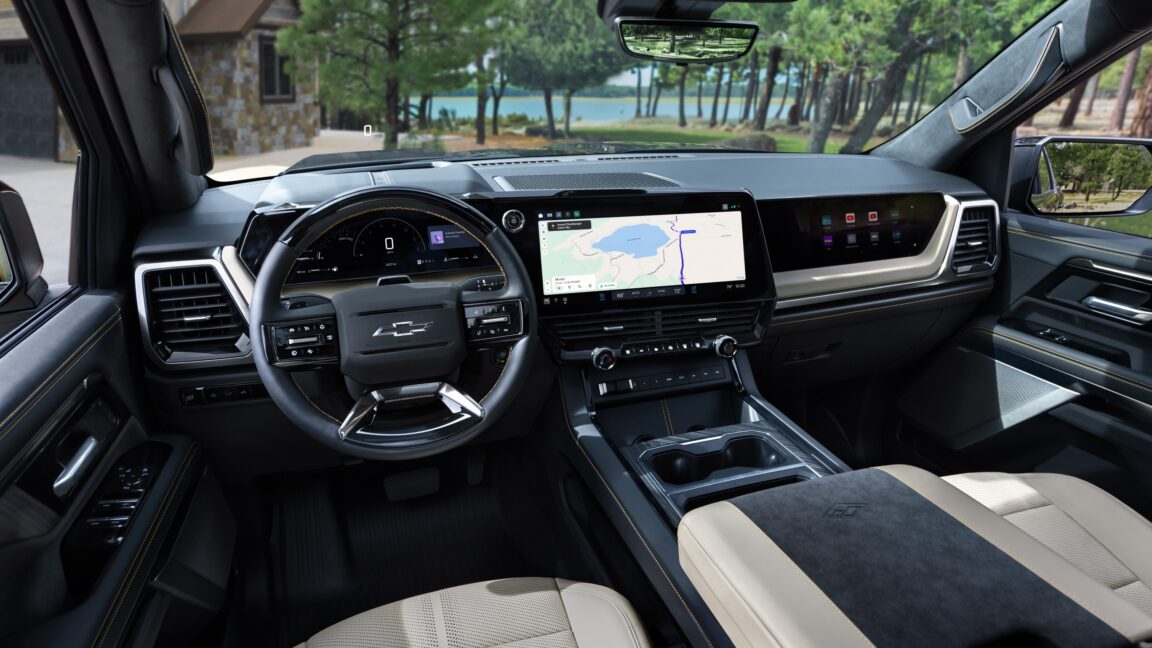
In the upcoming 2027 Chevrolet Silverado and GMC Sierra, drivers will actually be allowed to plug their phones in and see their own apps o...

Popular Posts