
Construction bosses and weekend boat haulers do not care about silicon-valley visions of dashboard commerce.
They want their podcasts and their text messages without paying GM an extra monthly toll.
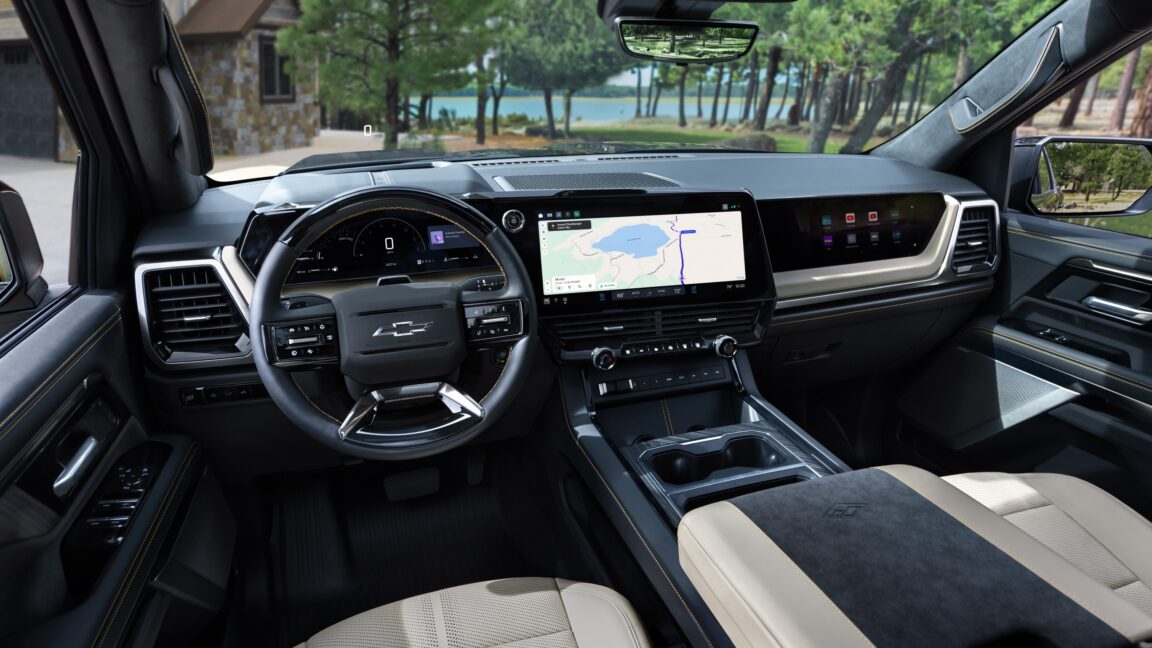
At the wheel, the visual noise has vanished. Drivers will look at deep black instrument clusters illuminated by local dimming backlights, meaning the dark parts of the glass do not emit an awful grey glow during pitch-black highway runs. The look borrows straight from the beloved Saab Night Panel of thirty years ago, when the Swedish brand shut off every dial except the speedometer needle to save tired eyes. If you do not care to see your engine revolutions or tire pressures at two in the morning, a tap turns the whole panel off, leaving nothing but clean white numbers floating in the dark. Silence is a design choice.
The Sudden Return To Senses In Detroit Boardrooms
Under the center touchscreen sits a row of heavy physical buttons and twist dials. You can adjust the cabin fan, clear the frosty windshield, and dial the heat up without taking your eyes off an icy road. Software engineers across the car industry spent the last decade trying to persuade us that tapping an iPad screen three times to turn on a seat heater was futuristic.
It was never futuristic.
It was just cheaper to manufacture.
Putting actual dials back into the highest-volume vehicles in America admits what drivers knew all along.
And the software notification logic finally behaves like an adult designed it. An incoming phone call pops up as a slim banner across the top of the glass, leaving your navigation map running undisturbed underneath. Previously, an unexpected ring would hijack the entire screen, blanking out the turn-by-turn map three seconds before your turn off a six-lane highway.
Small fixes like this prove that real human beings actually sat behind the wheel of these prototypes before approving the production run.
Behind the steering wheel, the Super Cruise graphics show clean green visuals whenever hands-free driving takes over. The cluster uses simple half-moon gauges for engine speed, but it instantly reconfigures into an off-road level meter or a trailer-sway monitor depending on what hitch you drop onto the bumper. The graphics do not attempt to look like an arcade game. They deliver raw information, take a step back, and shut up.
The Cold Cash Arithmetic Behind Phone Screen Casting
Across the automotive industry, customer surveys have shown that nearly half of new car buyers will walk away from a showroom if the dashboard locks out their phone. General Motors took that gamble on early buyers of the Chevrolet Blazer EV, betting that bespoke software would create billions in recurring digital fees. The bet backfired into a storm of software bugs, critical press reviews, and angry early adopters stranded at charging plazas.
Nobody wants to rent an operating system for a car they already bought.
So the Silverado and Sierra keep phone projection because truck buyers command absolute respect in the balance sheet. These two truck lines generate the towering profits that fund GM's electric experiments. Risking a mutiny among Silverado buyers would ignite an existential crisis for the corporate treasury. Apple and Google built software environments that people trust with their daily lives. Handing that convenience back to truck drivers is the only move that makes financial sense.
Why Car Software Fails When Tech Hubris Ignores Drivers
Detroit software executives spent five years trying to copy the iPhone business model without understanding why people buy vehicles. In 2024, GM brought in former Apple software veteran Baris Cetinok to rebuild its digital design division after the disastrous rollout of native in-car operating systems.
The dots connect directly from that leadership shakeup to this stripped-back 2027 truck interface.
Tech leaders assumed drivers wanted endless dashboard apps, but everyday commuters actually want their vehicles to act like invisible appliances that respect their attention.
Automakers believed they could build their own walled software ecosystems to capture customer data and sell streaming services. The strategy ignores basic human behavior. Drivers spend thousands of dollars on their personal phones, carefully setting up their playlists, map bookmarks, and messaging contacts. Asking a commuter to rebuild that entire digital life inside a truck dashboard creates pure friction.
To see how customer pushback changes corporate strategy, read the J.D. Power U.S. Tech Experience Index Study, which tracks how built-in infotainment systems trigger far more owner complaints than simple phone projection tools. Look at the McKinsey Connected Car Consumer Survey for hard data on how younger buyers reject native car apps. The 2024 technical case study on the Chevrolet Blazer EV software stop-sale reveals the dangers of ditching proven systems before in-house replacements are ready.
Hardware Specs And Digital Changes In 2027 Trucks
Inside the dash sits an updated electronic architecture running Android Automotive OS underneath, but with Google Automotive Services wrapped in GM's bespoke skins. The primary instrument panel features full array local dimming mini-LED hardware, driving contrast ratios past typical automotive LCD panels to stop light bleed during night drives.
Custom quick-action trays let owners pin winch controls, auxiliary lighting, and bed-camera feeds directly to the home screen.
Over-the-air firmware updates now run in dual-partition memory banks, allowing code to flash in the background without locking owners out of their vehicles during a software update cycle.


No comments:
Post a Comment