
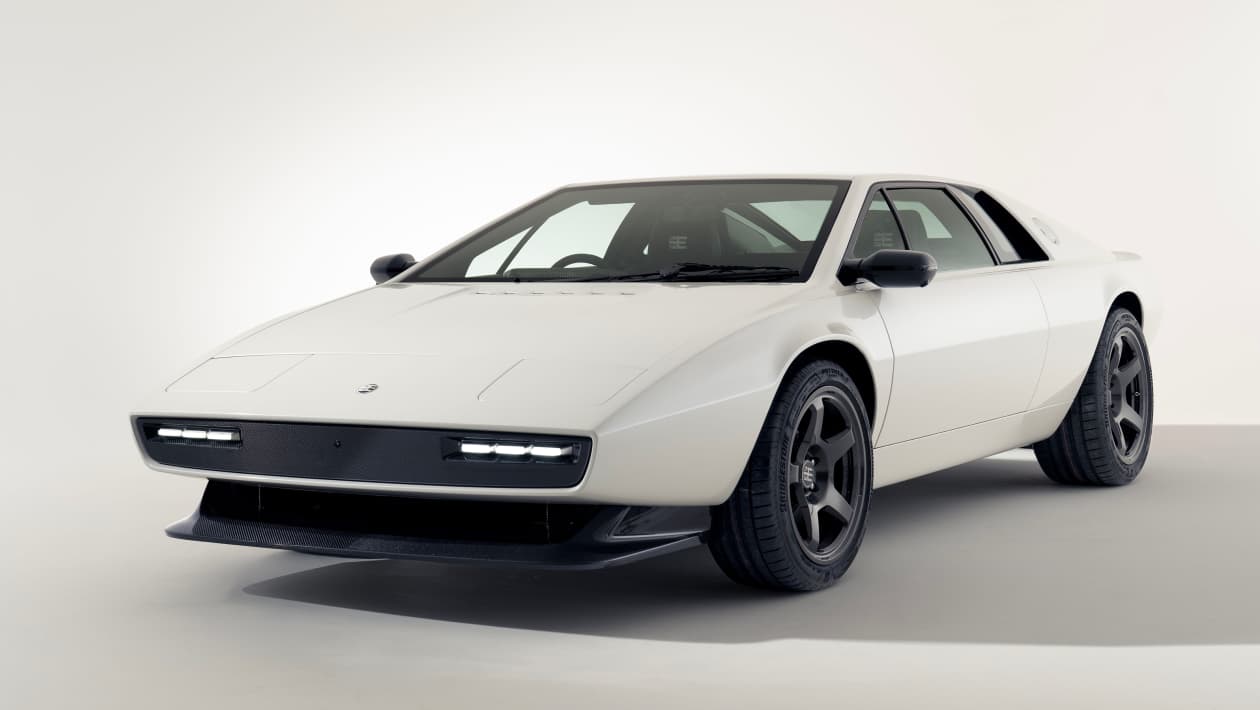
Joyful news, really. A wedge of perfection. That sharp, geometric elegance, suddenly resurrected not as an echo, but as a defined statement of future capability. Encor, the Essex-based specialists—with lineage stretching back through the rigorous halls of Porsche, the bespoke craft of Pagani, the sheer speed of Koenigsegg—have presented the Series 1. This isn't just nostalgia encased in polished resin.
It is deliberate, high-stakes engineering, focused entirely on the vehicle's inherent potential.
The Geometry of Respect
Daniel Durrant, the man who shaped the exceptional Lotus Emira, led this effort. A massive responsibility. He articulated the fundamental truth of the original: the Esprit S1 was uncompromised, forward-thinking. To touch that iconic Giugiaro shape is to tread lightly, with meticulous attention to line and intent.
Encor's operative philosophy is "respectful enhancement." The core aim: preserving that instantly recognizable automotive form while ensuring the machine actually delivers on the promise inherent in its sharp silhouette. The early Esprit always looked like it could pierce the atmosphere, but the physical reality was often tempered by period technology.
Now, the visual expectation aligns perfectly with the performance outcome.
The Calculated Balance
Under the new carbon fiber skin, everything relevant to dynamics is rigorously reconsidered. The Series 1 demands performance that was unthinkable in 1976. Now, a V8 engine produces approximately 400bhp and 475Nm of torque.
Four hundred horses, pulling less than 1,200kg. Feather light. That dramatic power-to-weight ratio translates directly to swift, confident movement: 0-62 mph happens in just four seconds. A top speed reaches 175 mph. Serious velocity for such a beautiful, sharp object. The drivetrain refinement is deeply meticulous. While conceptually a five-speed manual, the gearbox is entirely rebuilt for modern, sustained forces.
A stronger input shaft. Revised ratios within. They included a helical limited-slip differential and a bespoke twin-plate clutch—ensuring precision and durability the original chassis assembly never knew it needed. The meticulously stripped and refinished chassis served as the foundation for modern componentry. Bilstein shock absorbers and Eibach springs were fitted, adopted directly from the most extreme factory variant, the Esprit Sport 350. Serious componentry.
AP Racing brakes sit neatly behind the billet-machined wheels, ready for deceleration duty. Yet, amidst all the modernity—the composite body, the aggressive braking—one critical element remains stubbornly analog. The steering. Encor specifically retained hydraulically assisted steering over an electric set-up. No numbness allowed.
The crucial, tactile link between driver and tarmac remains unbroken. They wanted that specific, communicative Lotus feel. That necessary conversation with the road surface.
If you're still struggling to think of stuff for your Christmas list, and have been a particularly good petrolhead this year, may we suggest this ...Here's one of the sources related to this article: Visit website


No comments:
Post a Comment